
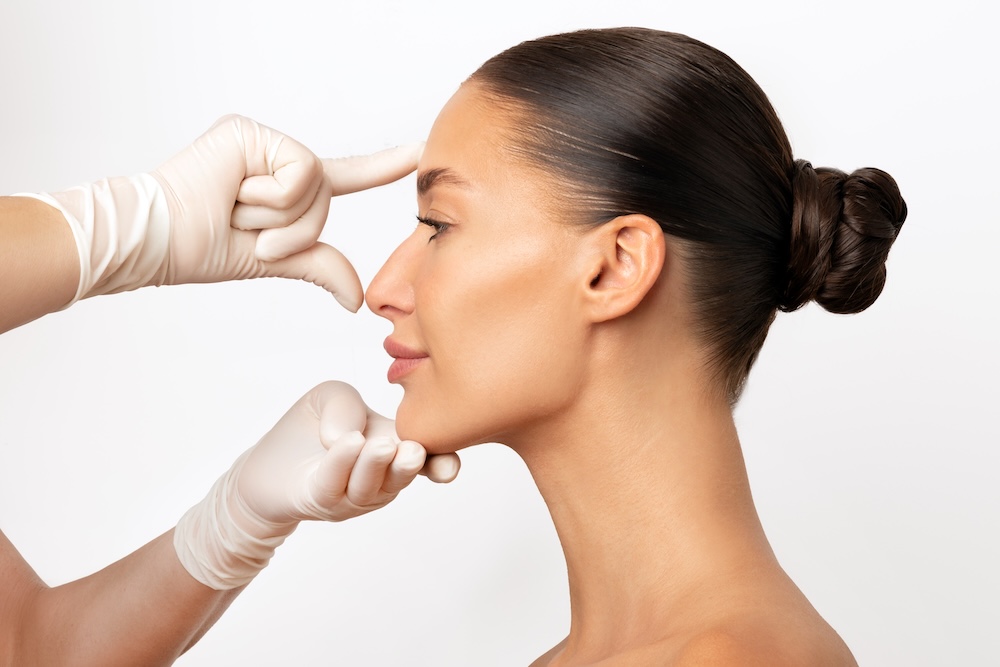
Rhinoplasty, commonly known as a nose job, is one of the most popular facial plastic surgery procedures. Patients often have questions about cost, recovery, pain, breathing, whether they will still look like themselves, and what happens if they are unhappy with a previous rhinoplasty result.
Below, our double board-certified Philadelphia facial plastic surgeon, Dr. Jonathan Pontell, answers some of the most frequently asked questions about rhinoplasty.
How much does a rhinoplasty cost?
In our practice, the surgical fee for rhinoplasty typically ranges between $10,000 and $15,500.
In addition to the surgical fee, there is also an anesthesia and facility fee, which can range from approximately $2,500 to $3,500.
Learn more about the cost of rhinoplasty.
What is recovery like after rhinoplasty?
Recovery from rhinoplasty is usually very manageable.
Dr. Pontell explains that, while he would not say there is zero pain, patients typically do not complain of significant pain after rhinoplasty. Many people assume rhinoplasty will be very painful because bumping the nose can hurt quite a bit. However, the reality is that most patients do not describe the recovery as very painful.
Patients are usually given gentle pain medication, such as Tylenol® #3, and some patients only need plain Tylenol.
Overall, rhinoplasty recovery is generally not considered a difficult or painful recovery.
How long is the downtime after rhinoplasty?
Patients are typically able to return to work after about one week and are usually looking presentable at that point.
There will still be swelling after surgery, but much of the early visible swelling improves within the first several weeks.
Will I still look like myself after rhinoplasty?
Yes. Dr. Pontell explains that patients still look like themselves after rhinoplasty.
The eyes are one of the biggest features that distinguish one person’s face from another, and the eyes do not change during rhinoplasty. While there will be some change in appearance, many people may simply think the patient looks better, changed their hairstyle, or got different glasses — without knowing exactly what changed.
Most people look at the face as a whole, rather than focusing on individual features. Unless a feature is very unusual or out of proportion, others may not remember the small details of the nose that bothered the patient before surgery.
What is the difference between an open and closed rhinoplasty?
A closed rhinoplasty is an older technique, while open rhinoplasty is a newer technique.
With open rhinoplasty, there is a small incision in the columella, which is the strip of tissue between the nostrils. This incision allows the surgeon to lift the skin and see the underlying structures of the nose more clearly.
According to Dr. Pontell, open rhinoplasty allows for very accurate and precise changes. It gives the surgeon the ability to perform a more sophisticated rhinoplasty that is designed to stand the test of time.
Which is better: open or closed rhinoplasty?
Dr. Pontell prefers open rhinoplasty because it allows for better visibility of the nasal structures and more precise surgical changes.
This approach can be especially helpful when making detailed refinements or when addressing both cosmetic and functional concerns.
Can rhinoplasty fix my breathing?
Yes. Rhinoplasty can address breathing issues at the same time as cosmetic concerns.
Many patients have breathing problems related to the septum or turbinates. The septum is the structure that divides the inside of the nose, and the turbinates are structures inside the nose that can contribute to nasal obstruction.
It is common for Dr. Pontell to work on breathing issues during the same surgery as an aesthetic rhinoplasty.
When will I see my final rhinoplasty result?
Many sources say it takes about a year to see the final result after rhinoplasty. While it can take that long for every last bit of swelling to fully resolve, Dr. Pontell explains that most patients see the vast majority of their result much sooner.
Even when the cast first comes off, patients usually have a good idea of what the final result will look like.
There is swelling immediately after surgery, but the majority of swelling is typically gone by about six weeks. By that point, patients are seeing something close to the final result.
What is a liquid rhinoplasty?
A liquid rhinoplasty is a non-surgical treatment that uses dermal filler material, such as Restylane®, to add volume to specific areas of the nose.
For example, if someone has a bump on the nose, filler can sometimes be placed above and below the bump to make the profile look smoother. If someone has a depression on one side of the nose, filler can be placed in that area to improve symmetry so both sides appear more balanced.
Liquid rhinoplasty does not surgically reduce or reshape the nose, but it can be used in select cases to create better balance and contour.
What if I had a rhinoplasty and do not like the result? Can it be redone?
Yes. A revision rhinoplasty can be performed if a patient is unhappy with the result of a previous rhinoplasty.
Dr. Pontell explains that his practice performs a significant number of revision rhinoplasty surgeries. The vast majority of revision patients are individuals who had their first rhinoplasty performed by another surgeon.
Between Dr. Pontell and Dr. Weng, the practice has performed over 6,000 rhinoplasty procedures, giving them extensive experience with both primary and revision rhinoplasty.
How long do I have to wait before getting a revision rhinoplasty?
Typically, patients should wait at least one year before undergoing revision rhinoplasty.
This allows the swelling to fully resolve and gives enough time to see the true final result from the first surgery. Waiting also helps the surgeon evaluate what needs to be corrected as accurately as possible.
Considering Rhinoplasty?
Rhinoplasty can address cosmetic concerns, breathing issues, or both. The best approach depends on your anatomy, goals, previous surgical history, and whether you are seeking a first-time rhinoplasty or a revision procedure.
A consultation with Dr. Pontell can help determine whether rhinoplasty, revision rhinoplasty, or a non-surgical option such as liquid rhinoplasty may be appropriate for you.